A hedge on the boundary: distance and density
Many thuja hedges start the same way: a row of young thujas right against the wire mesh, three to a metre, so that it screens as soon as possible. Ten years on, part of the hedge is on the neighbour's side, the inside is brown, and the back can only be trimmed from the neighbour's garden.
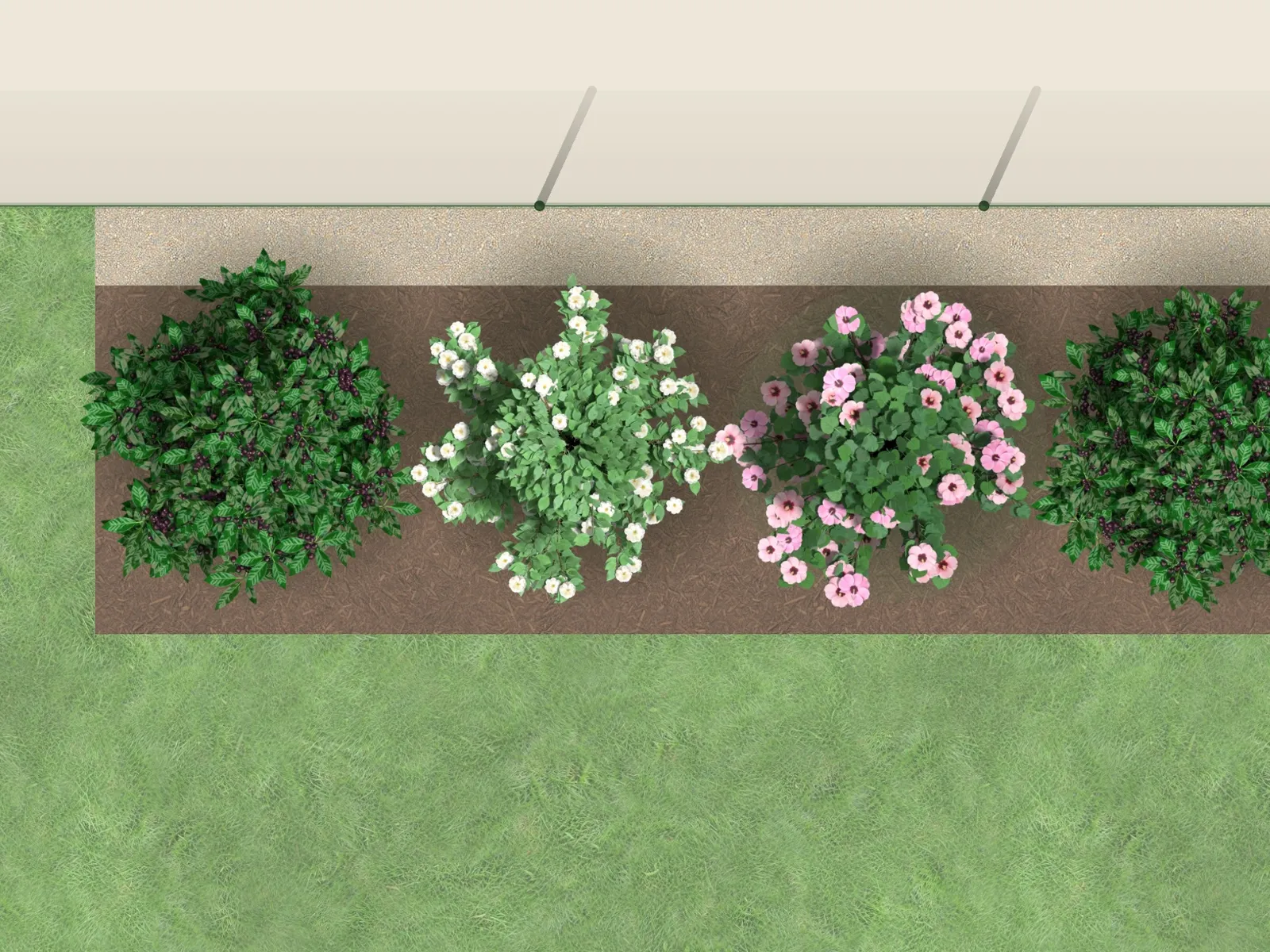
I drew this strip along the fence twice. It is a strip 14 metres long and 6 metres deep at the edge of a garden, along the wire mesh fence on the neighbour's side. The first version is how many thuja hedges are planted, the second is how it is worth doing. Both plans show the strip from the same view, with every plant at its mature size: as it will look in five to ten years, not as it looks when we bring it home from the garden centre.
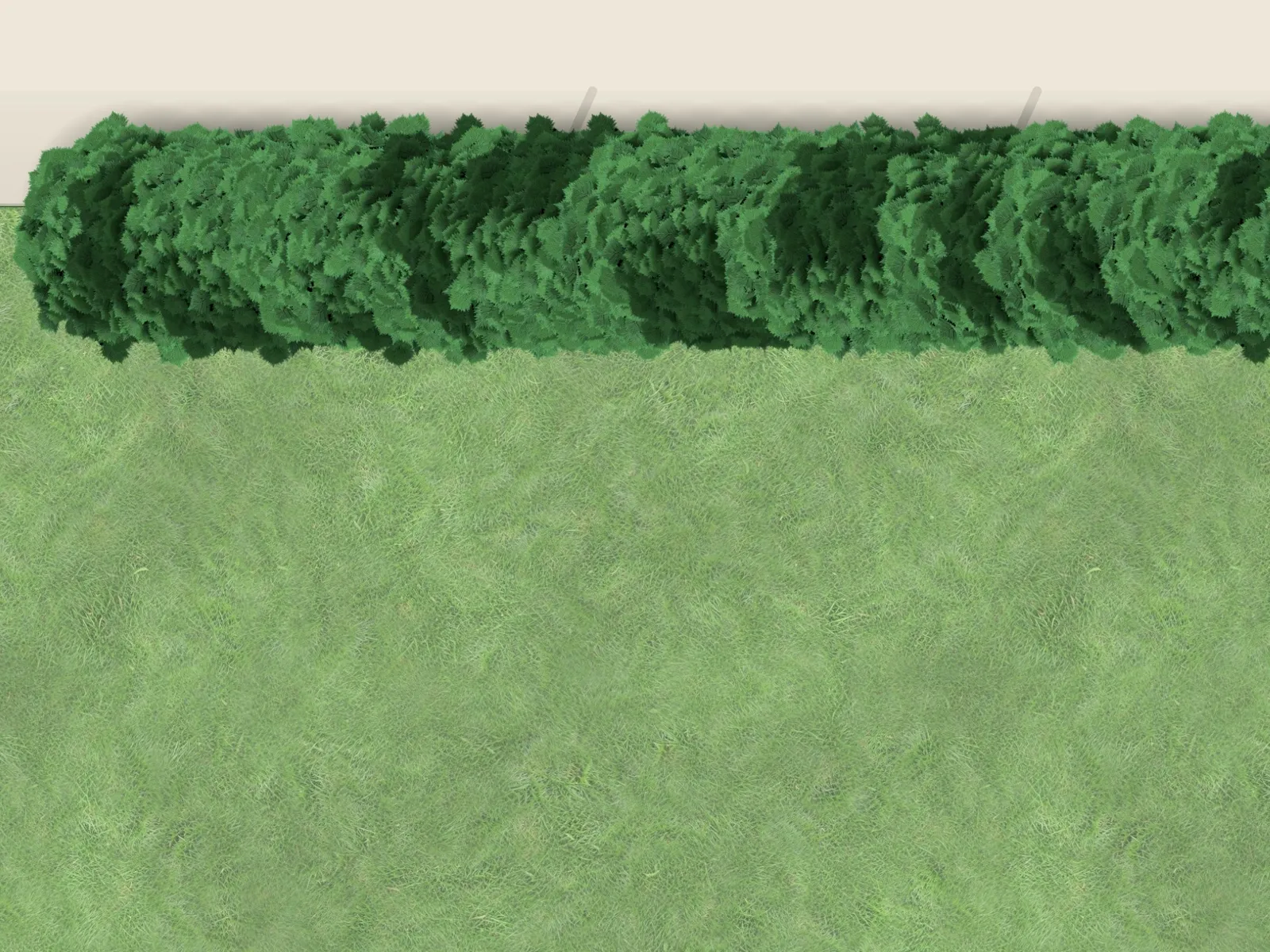
- Before · 41 'Smaragd' thujas 34 cm apart, 20 cm from the fence
- After · 7 mixed shrubs 2 metres apart, 1.5 metres from the fence
Tap a picture to view it full size.
How much room does a hedge need?
Before planting, two questions are worth asking. How wide will the hedge be when it is mature? And where will you trim its back from?
Thuja occidentalis 'Smaragd' (white cedar) is about 1.2 metres wide when mature. If its stem is planted 20 cm from the fence, its foliage reaches 40 cm over to the neighbour's side, and the wire mesh ends up in the middle of the hedge. From then on, the back can only be trimmed from the neighbour's garden.
A simple rule of thumb: the row of stems should be at least half the hedge's mature width from the fence, plus another half metre where you have room to trim. In the second plan the shrubs grow 2 metres wide, so the row is 1.5 metres from the fence: 1 metre for the foliage, and half a metre for the gravel strip behind it.
What do the rules say?
At the boundary it is not enough to plan for the hedge's width alone. Local rules may set a planting distance, so check this with your own municipality before you buy.
Even so, leave enough room to prune and care for the hedge from your own garden. Whatever grows over to the neighbour's side can easily lead to a dispute, even if you planted it within the rules.
How densely?
That depends on whether you trim the hedge.
A clipped hedge is usually planted with two or three plants per metre, and both sides are cut back regularly from the first year. Then the hedge is as wide as you trim it, say 60 cm, and the distance from the fence should be set to match.
In an informal hedge, the plant decides the width. Here the spacing between plants (measured from the centre of one to the centre of the next) should roughly match their mature width: that way neighbouring foliage just meets, and no plant has to grow into another's space.
A thuja row goes wrong when the two are mixed up. Three thujas go in per metre, as for a clipped hedge, and are then left to grow freely. Each plant would like to be 1.2 metres wide, but gets only 34 cm. The inside of the row gets no light, the plants compete for the same little water, and the foliage starts to brown from the inside. On a thuja, browned, bare stretches of branch do not green up again, so once a patch is bare it stays a gap.
Summer drought makes things harder too. White cedar comes from the cool, wet regions of eastern North America, so it copes with long, dry Hungarian summers only with regular, deep watering. In a single-species row a pest can also spread easily, the juniper jewel beetle for example. In recent years this pest has caused serious damage to thuja, false cypress and juniper in many gardens. That is why, when planning a new hedge, it is especially worth avoiding long rows of a single species.
The second version: a mixed hedge, planted for its mature width
In the better plan, seven plants of three kinds of shrub stand in the row, each growing about 2 metres wide:
- Prunus laurocerasus 'Etna' (cherry laurel): a glossy evergreen, with bronze shoots and white flower spikes in spring. Three plants, at both ends of the row and in the middle. It needs regular watering for its first few years, and later too in a dry summer.
- Philadelphus 'Schneesturm' (mock orange): covered in fragrant, double white flowers from mid-June to the end of July, bare in winter.
- Hibiscus syriacus 'Woodbridge' (rose of Sharon): pink flowers from midsummer to early autumn, bare in winter.
These three often go together in a mixed hedge, and they grow to roughly the same height and width. That matters a great deal when mixing species: none of them crowds out the others. Their flowering follows on: the cherry laurel flowers in April–May, the mock orange in June–July, and the rose of Sharon from July to September. In winter only the three cherry laurels are green, so the hedge is thinner then. If you need full cover in winter too, cherry laurel can take the place of the mock oranges as well. If one species is hit by disease, the whole row does not die at once.
The plants are exactly 2 metres apart, in one line. On the plan I laid a ruler marked every 2 metres along the row, and the plants lined up with its marks. In the garden, a taut string line and a measuring rod do the same job.
In its first years this hedge will have gaps. Don't fill them with more plants: you are keeping free the space the plants will need in a few years. Until then, cover it with mulch, or plant annuals in it.
If the strip is narrow
If the strip along the fence is narrower than a metre, don't try to force a conventional hedge into it. Look instead for a smaller or columnar-growing shrub, and plan for its mature width too.
The aim is not only that the plant fits, but also that later you can care for it and prune it all the way along from your own garden.
What the plan showed
At planting a thuja is still narrow, so it is hard to imagine how wide it will be in a few years. I drew both versions in Seasonry. One of Seasonry's core ideas is that you can plan a garden at its true scale. On the plan every plant is shown at its mature size by default, so you can see on the drawing that the thuja row grows over the boundary, and that 41 plants have no room in 14 metres. It shows not only whether the plants meet, but also whether usable space is left beside them for the fence, trimming and getting around.
With the “Fence” tool you can draw the fence where it really stands, and the “Ruler” sets out where the plants go: they line up with its marks. The Guide's lessons Draw fences and gates and Measure with the Ruler tool show them in detail. The “Fence” and the “Ruler” are both available in the free plan.
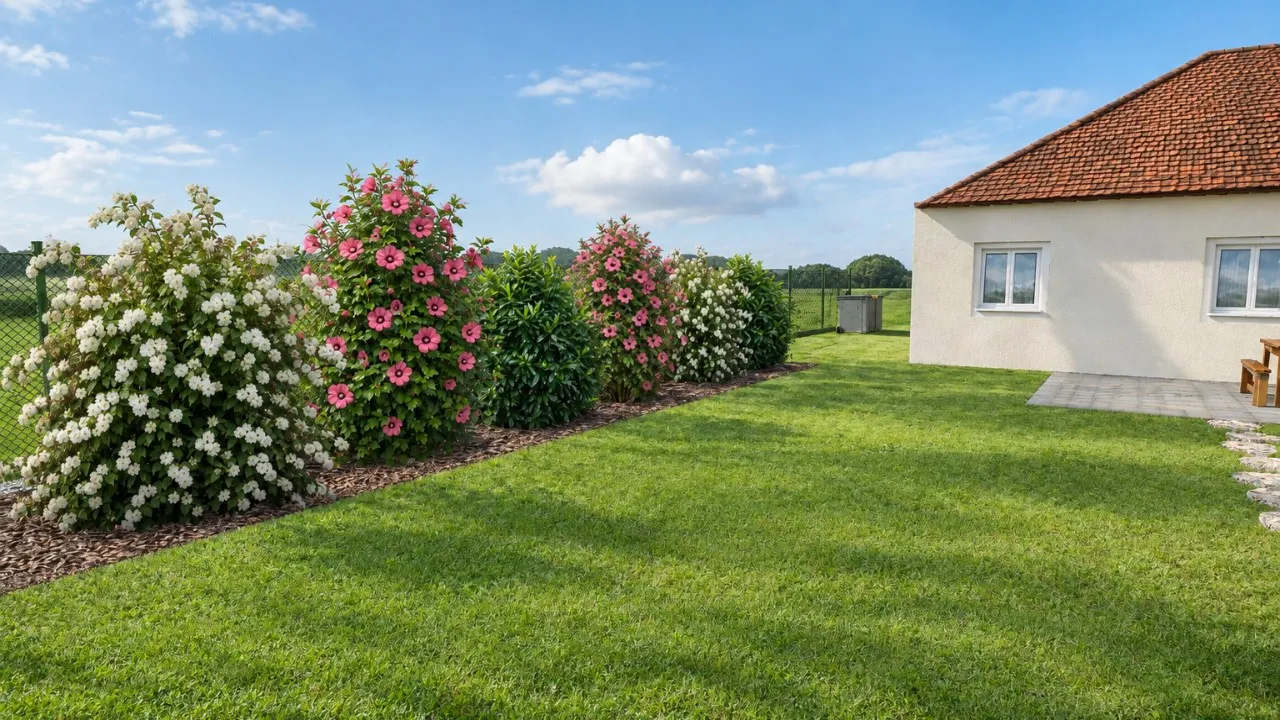
The picture at the top of this article was made from the same plan, with “Garden Visual”. You mark on the plan where you stand and which way you face, and Seasonry draws a photo-like picture of the garden from there, with every plant at its mature size. So you can also see from the lawn what the hedge will look like in a few years. “AI Enhance” made the picture more lifelike.
The garden below shows the better version along one edge of a whole 25 × 17 m plot. The plot also has a house, a natural stone terrace, a sour cherry and a perennial bed, and the gravel strip behind the hedge can be reached across the lawn beside the house.
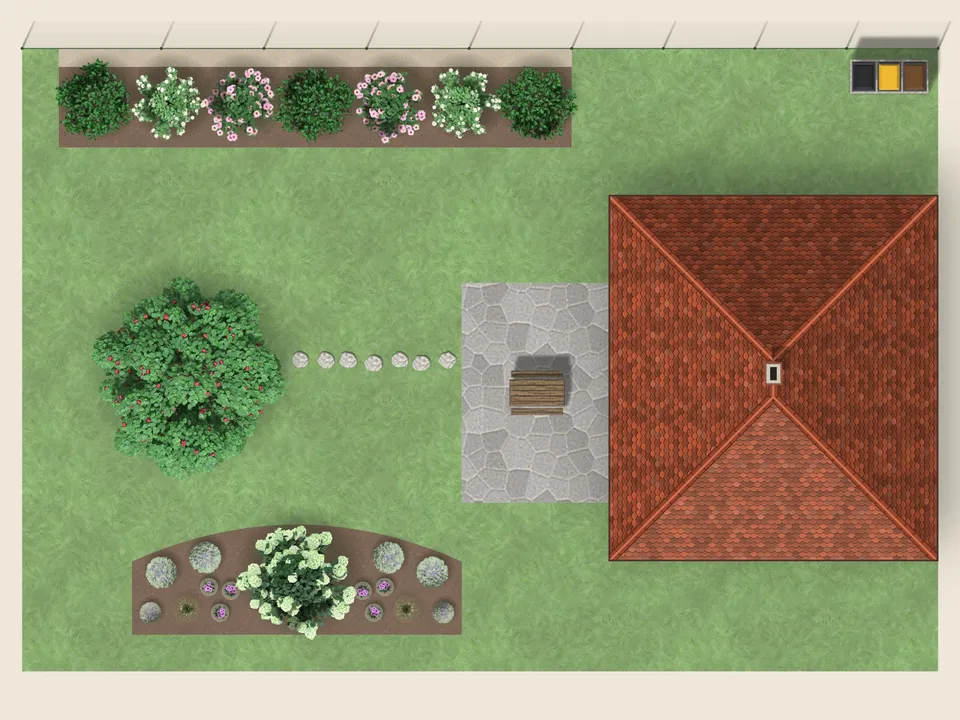
The garden for this article
A garden with a mixed hedge on the boundary
25 × 17 m plot · 9 species · 23 plants
A Seasonry file you can import into your own account.
You can edit and download it on a computer.