How big will it be in five years? Plant spacing by mature size
On planting day a well-planned border looks half empty. That is natural: plants need time and room to fill a bed.
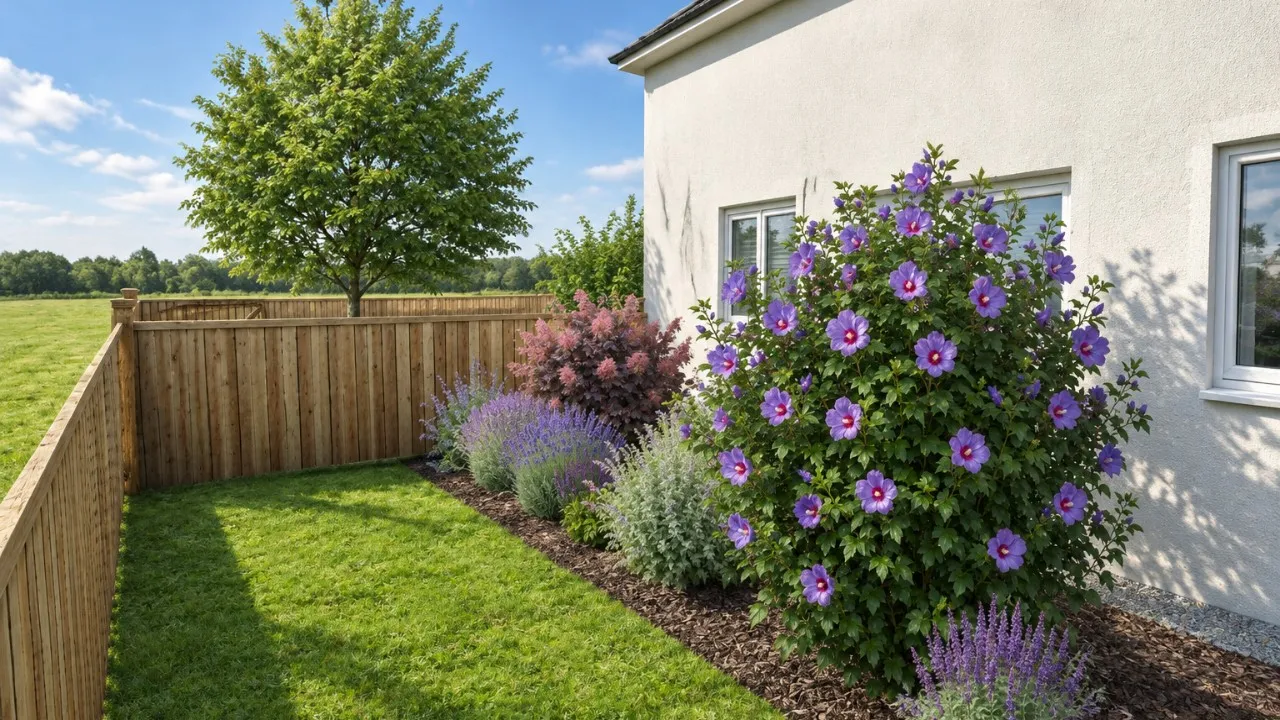
In autumn every shrub at the garden centre is small. A potted rose of Sharon is barely half a metre across, the smoke bush is no bigger, and a six-metre bed looks as if it could take ten of them. This is when almost everyone plants closer than they should, so that the bed looks full in its first summer.
Within a few years that changes. The rose of Sharon is two metres wide and leans over the path, the smoke bush grows into its neighbour, and the lavender is shaded out by the branches arching over it. Then you either cut the plants back again and again, or dig out a shrub that is already well established.
What does mature size mean?
The height and spread on the label or in the catalogue are the mature size: how big the plant grows if you let it. That takes time: shrubs reach their typical size over several years, while perennials often fill the space meant for them by their third summer.
When you plant, don't go by the size of the plant in its pot. Plan for the space it will take once it has settled in.
One rule to work it out
The spacing between two neighbouring plants (the distance from one centre to the other) is half of one mature spread plus half of the other. A smoke bush 1.5 metres across and a bluebeard 1.2 metres across therefore need 0.75 + 0.6 = 1.35 metres. In five years they just meet, without growing into each other.
Next to a wall, a path or a fence, add another 30–50 cm to half the spread, so you can get in, prune, and keep the leaves off the wall. A shrub that grows 3 metres wide, planted 1.5 metres from the house, will grow right up against the wall.
A boundary with a neighbour is a case of its own: there, local rules count as well as the plant's final size. They can differ from one municipality to the next, so before you plant, check how far from the neighbouring plot you have to keep.
The mature spread of the plants in our example:
- Hibiscus syriacus 'Russian Violet' (rose of Sharon): 2 m
- Cotinus coggygria 'Lilla' (smoke bush): 1.5 m
- Caryopteris × clandonensis 'Heavenly Blue' (bluebeard): 1.2 m
- Nepeta 'Walker's Low' (catmint): 90 cm
- Lavandula angustifolia (English lavender): 80 cm
- Salvia nemorosa 'Caradonna' (woodland sage): 45 cm
These are catalogue figures, the top of each plant's usual range: the real size also depends on the soil, watering and pruning. Better to leave a little space than to be pruning in two years' time.
The example: a sunny border in front of the house
The border is 6 metres long and 2 metres deep, in front of the south wall of a detached house. Behind it, a 40 cm gravel strip runs under the eaves: little rain reaches it, and it leaves room to get to the wall. The front path runs past the right-hand end of the bed, a slatted fence separates the left-hand end from the driveway, and there is lawn in front.
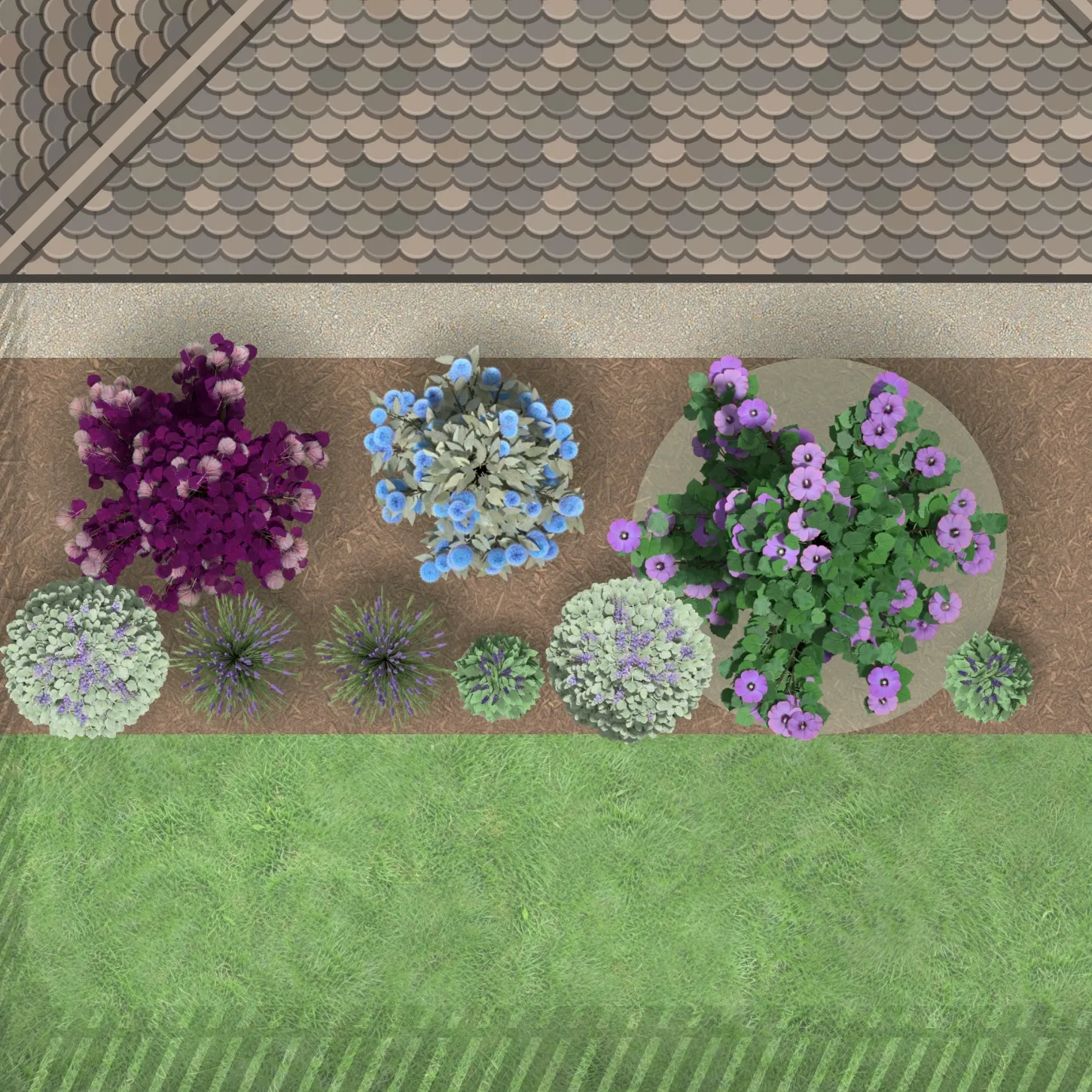
In front of a south wall the summer heat is fierce, and the chalky soil of many Hungarian gardens dries out quickly. So the plants here are drought-tolerant: three shrubs at the back, perennials in front. Both ends keep their margin: the smoke bush stands 1.2 metres from the fence and the rose of Sharon 1.5 metres from the path, so when they are mature their foliage stops 45 and 50 cm short. In five years the rose of Sharon still won't lean over the path, and there is room to get in and prune. A fourth shrub would not fit: with one a metre across, the rule calls for a bed at least 6.3 metres long. The two pictures below show the border from the same view, at planting and five years on.
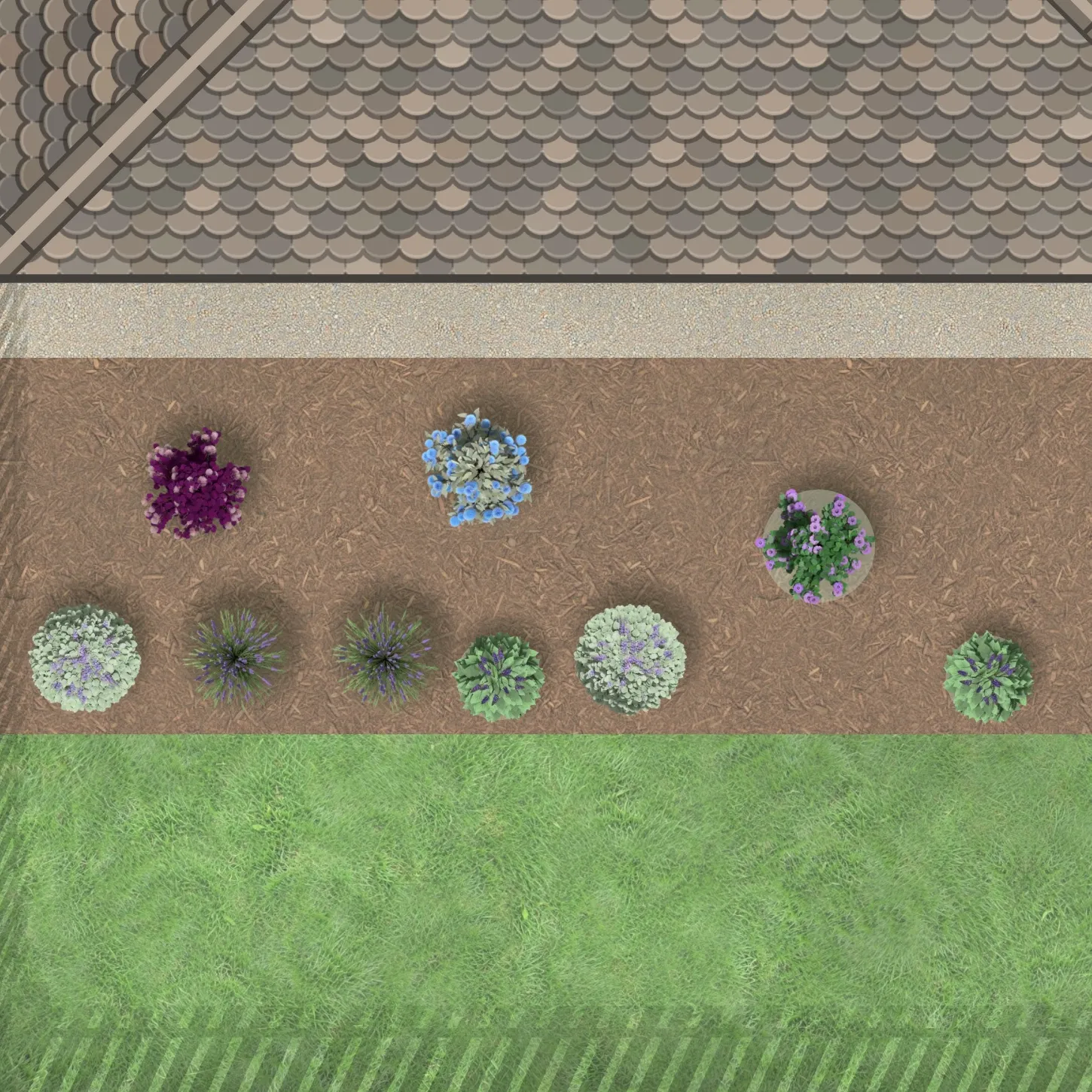
- At planting · the shrubs 1.5–1.8 m apart
- In five years · the same plants at mature size
Tap a picture to view it full size.
What to do with the empty space
For the first two or three years after planting there will be a lot of bare soil. It is not worth filling it with more shrubs:
- Mulch it. 6–8 cm of loosely spread bark holds moisture through summer drought, keeps the weeds down, and makes sparse planting look intentional.
- Plant annuals in between, or a fast perennial you will be happy to lift later. Put annuals out once the last frost is past.
- Add spring bulbs. Autumn is still the time to plant them, and in spring they fill the gaps before the shrubs come into leaf.
- Water rarely, but deeply. Newly planted shrubs need regular water for their first year or two, and infrequent, deep watering draws the roots down.
What if you plant close anyway?
Plants set too close compete for light, water and nutrients. In hot, dry spells the shared root zone dries out sooner. Air moves less freely through dense foliage, so fungal disease is more common. Shrubs grow lopsided, the lower plants struggle underneath them, and the border keeps its shape only with constant pruning.
It matters less with perennials, which can be thinned by division and are easy to move. Digging out a shrub that has been in for five years is hard work, though, and not every shrub takes it well. So with shrubs it pays to keep the final spacing from the day you plant, while with perennials you can be a little more relaxed.
How to see it in advance
On paper, the simplest way is to draw the bed to scale and mark every plant at its mature spread. Before planting you can mark their places on the ground too: a cane at the centre, and chalk spray or a line of sand around the edge of the circle.
We planned this border in Seasonry. One of Seasonry's core ideas is that you can plan a garden at its true scale. On the plan every plant is shown at its mature size by default, so the bed and the gaps between the plants relate to each other just as they will in the garden later. You can see on the drawing where canopies will meet, and where there is too much or too little room.
If a plant is still young, you can enter its present size in the “Current radius” field, and the “Footprint” button shows the space kept for it as a dashed circle. The “Overlaps” tool lists the trees and shrubs whose foliage would later meet. It deliberately leaves out perennials, because for them growing together is natural. All three are free, and the Guide's lesson shows them in detail.
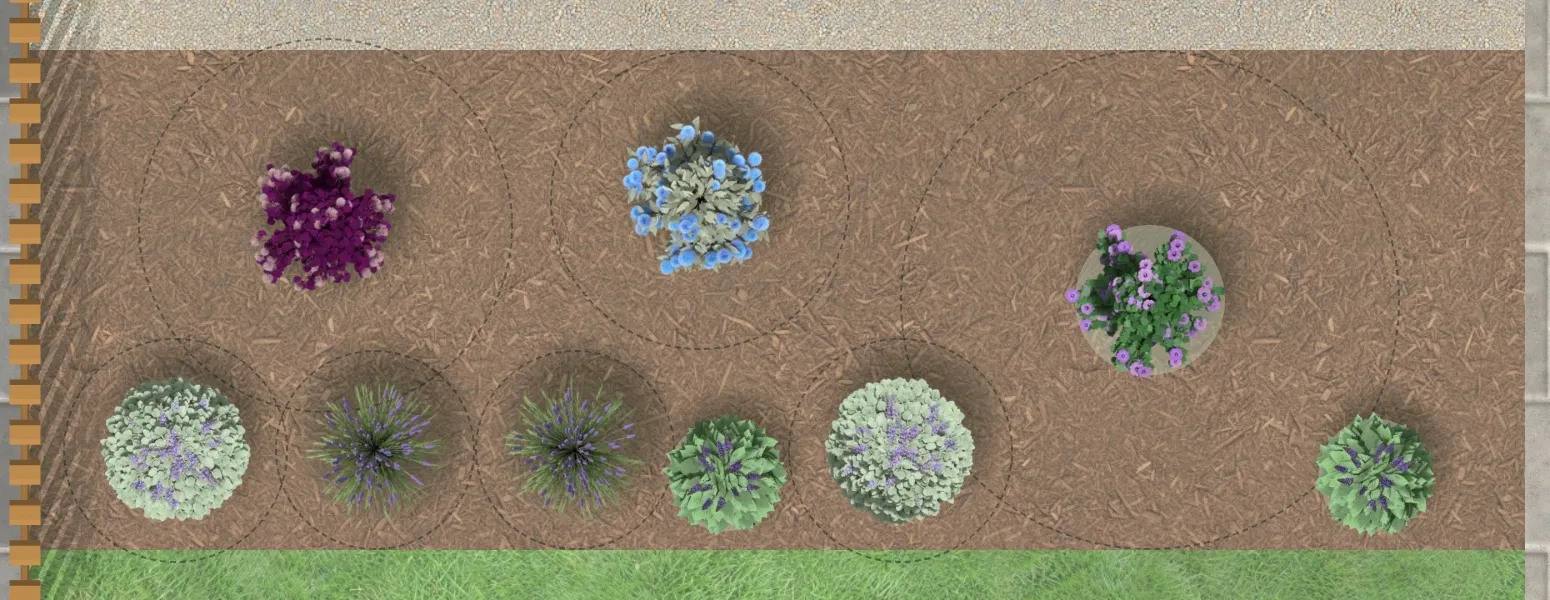
The picture at the top of this article was made from the same plan, with “Garden Visual”. You mark on the plan where you stand and which way you face, and Seasonry draws a photo-like picture of the garden from there, with exactly the plants you placed. Every plant appears at its mature size unless you entered a smaller one in the “Current radius” field, so you can also see from the path what the border will look like in five years. “AI Enhance” made the picture more lifelike.
In short
- Look up the mature spread, and work with the top figure.
- The spacing between two plants is half of each one's spread, added together.
- From a wall or a path: half the spread, plus 30–50 cm.
- Be strict with shrubs and more relaxed with perennials.
- Fill the empty space with mulch, annuals and bulbs, not another shrub.
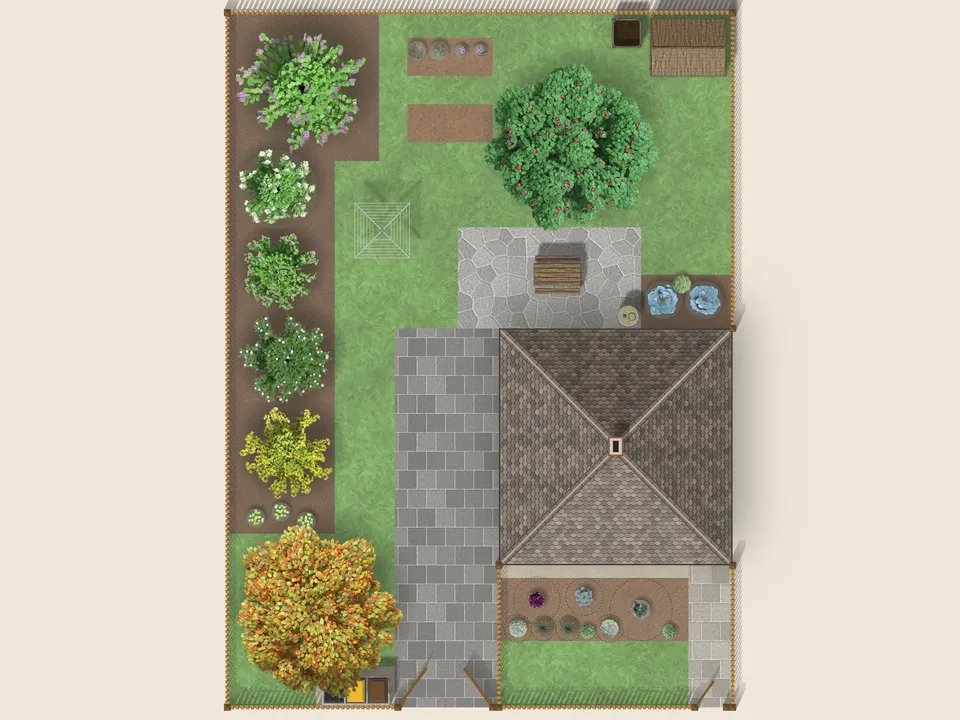
The garden for this article
A sunny border in front of the house
16 × 22 m plot · 18 species · 26 plants
A Seasonry file you can import into your own account.
You can edit and download it on a computer.